
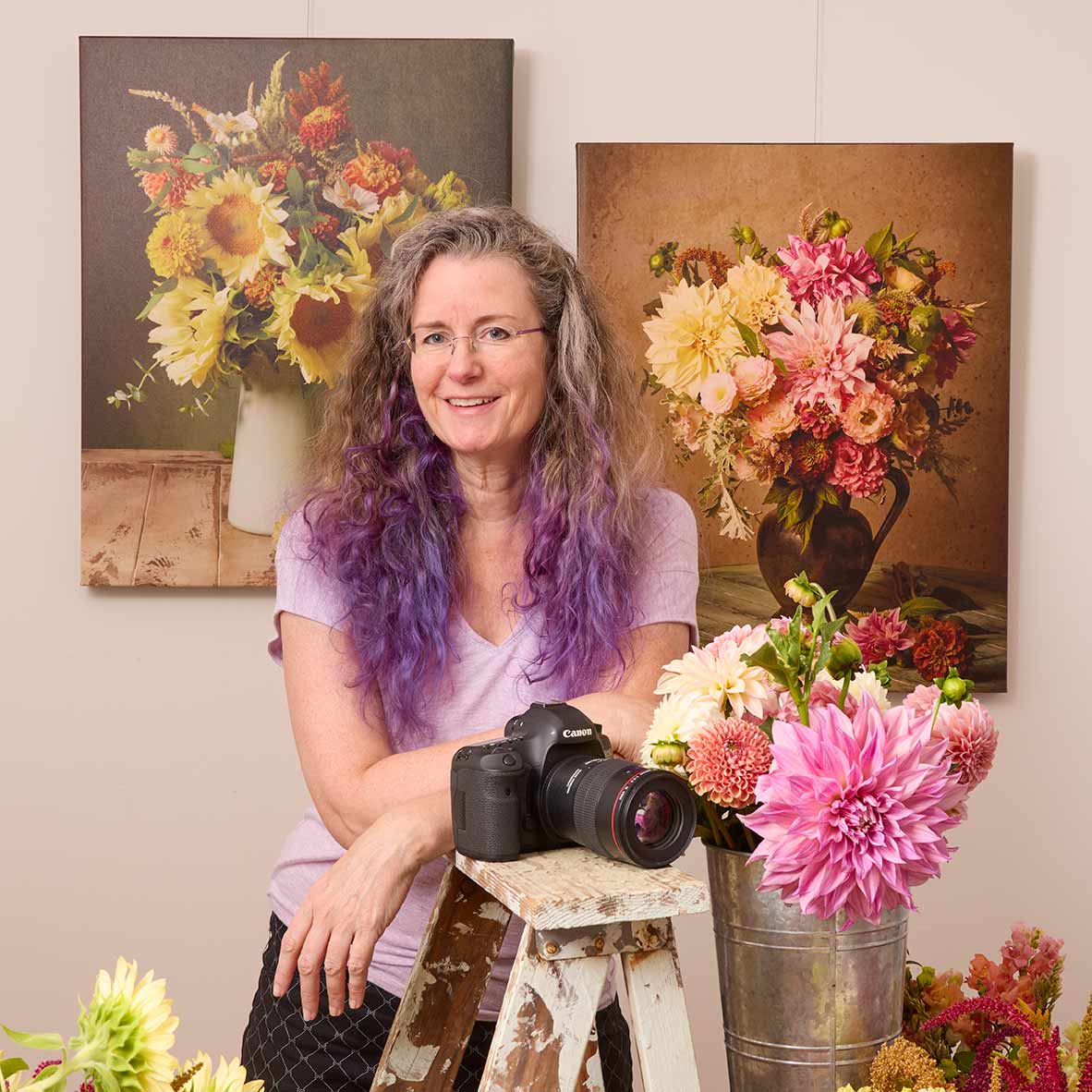
ABOUT CHRISTINA
My father, a chemist, gave me my first camera when I was eight, and by the time I was 12 I had my own darkroom. I thought he was raising a photographer. He was hoping for a chemist. When I chose photography, he refused to support it, so I moved out as a teenager and left for California at 19. The person who made me a photographer never wanted me to be one. I’ve made fine art on the side ever since, but his warning that I’d be a starving artist kept me from doing it full time.
After 30 years as a commercial food and floral photographer in Los Angeles, I’d grown tired of photographing food I no longer believed in.
In 2020, my husband and I moved back to Delaware to care for my aging parents. A week later, COVID shut everything down, and my commercial business disappeared.
In the middle of caring for my parents, a few bouquets from a local store started it all. Soon I was picking dahlias at a nearby flower farm and photographing them in my tiny studio. Those hours were the brightest part of my day. Hundreds of images later, they became this collection, made to bring you that same joy.

MY PROCESS
I go out of my way to make these images look effortless, but the reality is, they are far from that.
I'm planning my images months in advance and some images are a few years in the making.
I obviously have to time the shoot around the flowers' bloom cycles. Then I have to figure out all the props, backgrounds and surfaces to be used in the shot and get them if I don't have them already. One prop (a window frame) took me over a year to find.
Next I receive my flowers, process them, which means, clean their stems of excess leaves, cut their stems, give them flower food and let them rest for about 24 hours.
Once the flowers have been refreshed, they start to open up.
Now it's time to start building the arrangement.

THE ARRANGEMENT
I get asked all the time where I get my arrangements from. I build them on my photography set as I am taking pictures. This is the only way to build an arrangement that will look perfect on camera.
I learned this over 25 years ago when I was photographing flowers regularly for a high end grocery store in Los Angeles. We built every arrangement on set and through the eye of the camera.
Each stem is cut then placed in the container as I am taking pictures each step of the way.

THE FINAL IMAGE
I've been creating these floral portraits for several years now and I get asked the same questions quite often so I'm going to address those here.
These are photographs, not paintings. I am emulating the paintings of the Dutch masters that go back to the 1600's by using traditional design and composition.
I am using artificial light to emulate the natural lighting in the Dutch masters' paintings as well.
I am not using any filters or doing any kind of digital, AI manipulation on these images at all. The only digital work I do is clean up minor imperfections on petals and distracting blemishes on their antique containers.
Seriously, I hate doing digital work on the computer so I try to get as much done through the camera as I can.
I am shooting digitally using a Canon R5 camera with an incredibly sharp Canon TS90mm lens, and that's it.
There are no shenanigans here! What you see is what is on my set in my studio.

THE ARTWORK
I’ve been printing my own work since the very first Epson photo printer came out, before archival inks even existed. Making those early prints last took some creative workarounds, and 30 years of commercial work taught me even more about what makes a great print.
Every piece is available as a paper print or canvas, framed or unframed. For local art fairs, I print smaller pieces right here in my studio. Everything else, including every online order, is printed by a family-run lab here in the U.S. I spent years testing labs across the country before choosing one whose color and craftsmanship I trust completely.
These aren’t mass-produced prints like you’d find at a big-box store. Each one is made to look exactly the way it did on my set, and to last for years.
I want you to love what you hang on your wall. If a print arrives damaged, or it just isn’t right for you, I’ll make it right.
Behind The Scenes - Photos By Jim Coarse of Moonloop Photography in Delaware
-

Building The Arrangement
I build my arrangement one stem at a time.
-

Shooting
After almost every stem placed I take a picture to see how it looks on camera
-

At The Computer
I'm shooting tethered and that means as I take pictures they show up instantly in my computer
-

Finished Result
Once I clean up slight blemishes on the petals and any weird, distracting nicks or scratches on the vessel, the image is ready for print.


